

A customer in Kigali, Lagos or Nairobi used to type “best dentist near me” into Google and scroll through ten blue links. More and more, they now ask ChatGPT, Gemini, Claude or Perplexity instead, and they get one short answer with two or three names in it.
If your business is one of those names, you win the customer before they ever see a competitor. If it is not, you may never know you lost them: your website statistics show the visits you got, not the recommendations you missed.
This guide shows you how to check where you stand, first by hand, then automatically with Amaso, the free WordPress plugin we build at FOSIA.
What “AI visibility” means
AI visibility is simple: when someone asks an AI assistant a question your business should answer, are you named in the reply? Some people call the work of improving it GEO, for Generative Engine Optimization. It is close to SEO (being found on Google), but the “results page” is now a written answer.
Two things matter in that answer:
- Mentions: is your business named at all?
- Sources: which websites did the assistant rely on? If it quotes your website, it can see it. If it quotes a directory or a competitor, that is where your work starts.
Check it by hand in 15 minutes
- Write down five questions your customers really ask. Use their words, with your city and your service: “Which hotel in Musanze is close to the gorilla park?”, “Where can I buy organic tea in Kigali?”.
- Ask each question in ChatGPT, Gemini, Claude and Perplexity. Use a private window so your own history does not influence the answer.
- Note three things for each answer: whether your business is named, which businesses are named instead, and which websites are cited.
- Repeat in two weeks. One answer is not a trend. AI assistants change their answers, so only repeated checks tell you something reliable.
Five questions across four assistants is twenty answers. It is a useful first look, but few business owners have time to do it every week.
Check it every week with Amaso
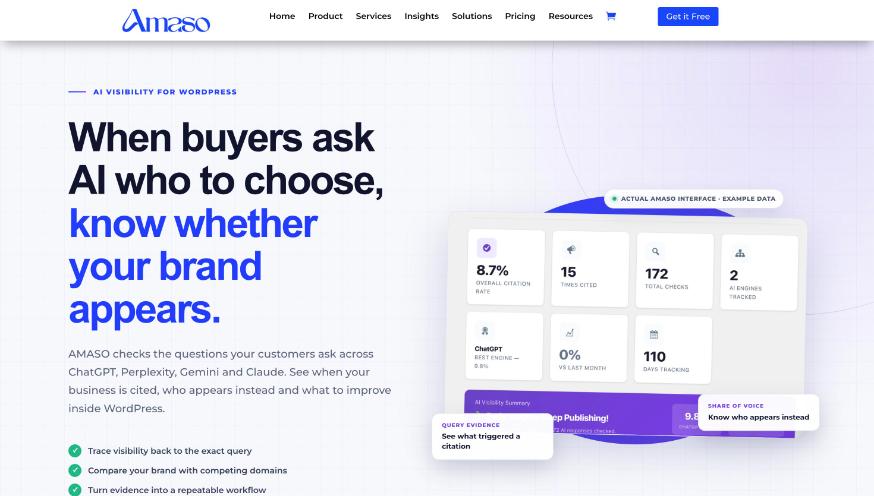
Amaso does the same work inside your WordPress dashboard. You list the questions your customers ask, and Amaso shows you, for each one, whether ChatGPT, Gemini, Claude and Perplexity cite your business, who appears instead, and the exact question, engine and date behind each result.
The free edition, Amaso Lite, is on WordPress.org. It includes:
- unlimited tracked keywords and unlimited AI citation checks, using your own AI keys (the AI providers bill that usage directly);
- automatic structured data (JSON-LD schema), which helps machines understand who you are and what you do;
- a generated llms.txt file, a short summary of your site written for AI tools.
Installing it takes about two minutes with the guided setup. Then the routine is three steps: track your questions, look at who is named, and fix what keeps you from being named (schema, llms.txt, FAQs, missing pages).
When the checks become part of your weekly work, paid plans start at $35.99 a year. They add things like Google Search Console data, more websites and AI assistants that apply fixes for you, with every change undoable. See Amaso pricing.
What results look like
Lens & Co by Tiara, an eyewear store in Lagos, went from 0 to 3 AI engines naming it (Google, ChatGPT and Claude, October 2026). That is one client’s measured result, not a promise: AI providers decide what they answer, and nobody can guarantee a citation. What Amaso gives you is the evidence, dated and repeatable, so you know whether your work is moving the needle.
Where to start this week
- Do the 15-minute manual check above and write down the results.
- Install Amaso Lite and add the same five questions.
- Watch the demo: in English or in French.
Prefer to have it done for you? AI visibility is part of our Digital-as-a-Service plans. Book a free call and we will look at your business together.

0 Comments