

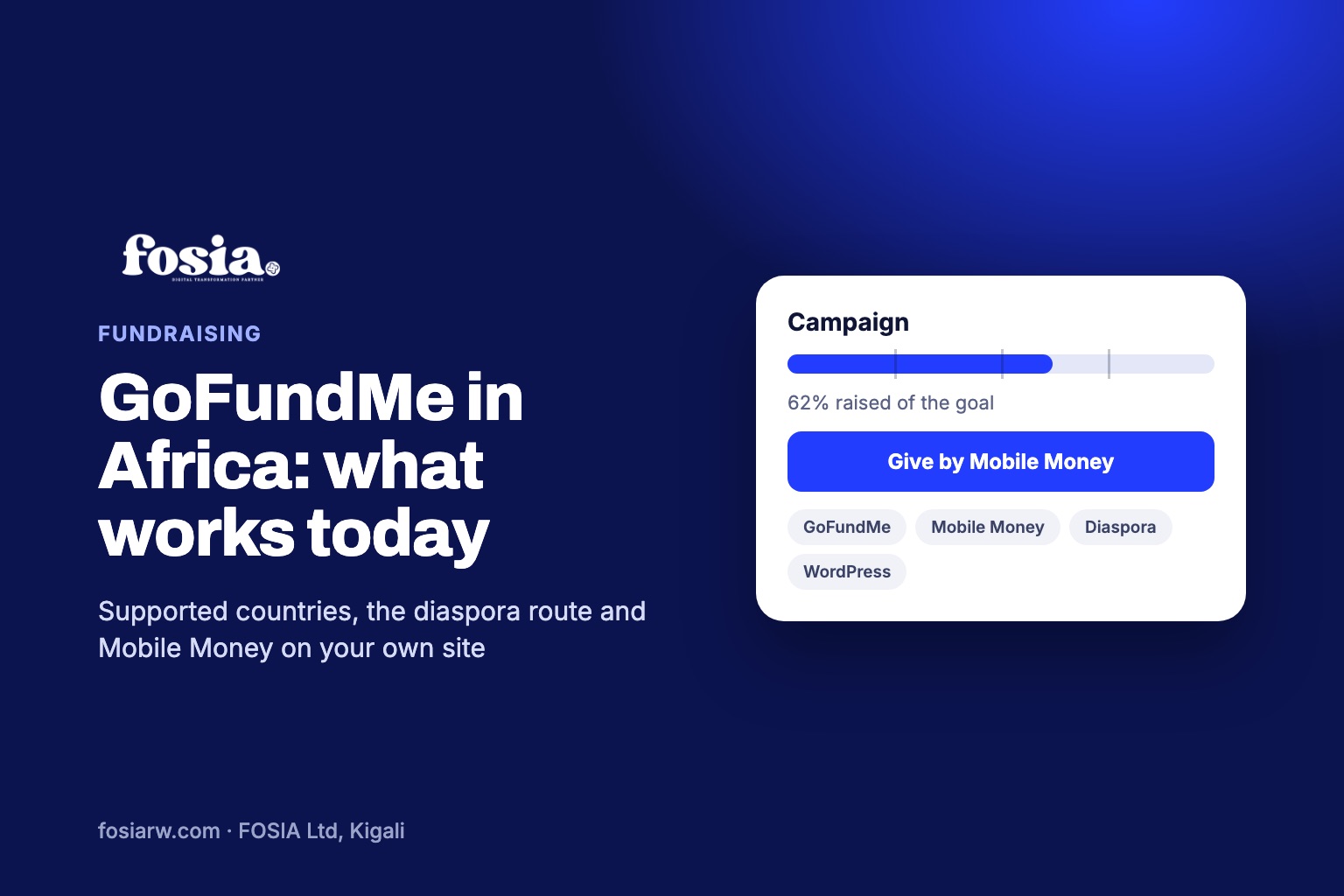
In short: using GoFundMe in Africa is limited: at the time of writing (November 2026), GoFundMe’s help centre lists 20 countries where a fundraiser can be created, in Europe, North America and Australia, and none of them is in Africa. A relative abroad can organise one for you and pass the money on, which suits donors with cards. When most of your donors are at home and pay with MTN MoMo, M-Pesa, Airtel Money or Orange Money, a Mobile Money fundraiser on your own WordPress site, with Fosia Crowdfunding, is the more natural route.
When a family in Kampala, Accra or Douala needs to raise money fast, the first name that comes up is often GoFundMe. It is one of the best known fundraising sites, and for good reason. But many people only discover its country rules after they have written their story. This guide explains what GoFundMe allows today, when it is still the right choice, and what to do when your donors pay by phone.
What GoFundMe does well
Let us be fair first. GoFundMe is trusted by donors in Europe and North America, its pages are easy to share, and its help centre explains its rules clearly. Its donor payment options include major debit and credit cards and, depending on the fundraiser, wallets such as PayPal, Apple Pay and Google Pay. If your supporters mostly live in London, Toronto or Paris and pay by card, GoFundMe is built for them.
Where GoFundMe works today
GoFundMe’s help centre says a fundraiser must be created in one of these countries: Australia, Austria, Belgium, Canada, Denmark, Finland, France, Germany, Ireland, Italy, Luxembourg, Mexico, the Netherlands, Norway, Portugal, Spain, Sweden, Switzerland, the United Kingdom and the United States. The country is chosen when the fundraiser is created and cannot be changed once it is published.
The person who withdraws the money must also meet that country’s requirements, which include being over 18, holding a valid photo ID and having a bank account in a supported country. GoFundMe adds that when an organiser who does not meet these requirements creates a fundraiser, the money raised is likely to be refunded. So a nurse in Lusaka or a pastor in Cotonou cannot simply open a GoFundMe in their own name. The list can change, so check the official page before you decide.
One more point: Mobile Money is not among the donor payment options listed in GoFundMe’s help centre at the time of writing.
The diaspora route, and its limits
GoFundMe does allow raising money for someone who lives in an unsupported country. In that case the organiser, who must be in a supported country, receives the funds and is personally responsible for delivering them outside GoFundMe, and should explain that plan to donors.
This works well when you have a trusted cousin in Brussels or a friend in Dallas. It has three weak points for many African families:
- Someone abroad has to agree to hold the money and send it home, which takes time and adds transfer costs.
- Donors at home, who are often the majority for a funeral or a hospital bill, are asked to pay by card, which many do not use.
- The campaign lives far from the people it concerns, and local updates are harder to share.
Start with one question: where are your donors?
The right tool depends less on the cause than on how your donors pay. Use this table as a first filter.
| Your donors are mostly… | They usually pay with… | A good fit |
|---|---|---|
| Abroad, in a GoFundMe country | Cards, PayPal | GoFundMe, run by a trusted organiser there |
| At home, in your country | Mobile Money | A Mobile Money fundraiser on your own website |
| Both | A mix | Your own website as the main page, with the diaspora sending through one organiser |
A Mobile Money fundraiser on your own website
Fosia Crowdfunding is a WordPress plugin built by FOSIA in Kigali for exactly the second and third rows. It turns your site into a fundraising page: a campaign with a goal, a progress bar, budget lines, updates and a donation form. Donors enter their phone number and confirm the payment on their phone.
How the pieces fit together:
- WooCommerce records each donation as an order, so you get a clean history.
- Fosia Pay handles Mobile Money. Fosia Pay Lite is free on WordPress.org.
- Your own PawaPay account receives the money directly. FOSIA never holds it and takes no commission; only PawaPay’s processing fees apply.
Fosia Pay covers 21 African countries and 43 Mobile Money networks, including MTN MoMo, Airtel Money, Orange Money, M-Pesa, Wave and Moov Money. Availability depends on what PawaPay has enabled on your merchant account.
The free Lite version already gives you unlimited campaigns and donations, WhatsApp, copy link and QR sharing, budget lines and updates, and a donations log with CSV export. Recent donors are shown anonymously by default, never with a phone number.
Using both, without counting twice
You do not have to choose one tool for everyone. Many families will want their own page as the main campaign, so that people at home can give by Mobile Money, while relatives abroad collect by card through one organiser.
If you take the Pro version ($29.99 a year or $89 for life), you can record offline gifts such as cash, church collections and bank transfers, with their source, shown separately from online donations. When the organiser abroad sends what they collected, record it as a bank transfer and your page shows one honest total. Pro also adds milestones, a matching sponsor, proof of spending with receipts and group collections.
Set it up in an afternoon
- Install WooCommerce, then Fosia Pay Lite, then Fosia Crowdfunding Lite on your WordPress site.
- Paste your PawaPay API token into Fosia Pay, copy the callback URL into your PawaPay dashboard, and test in sandbox first.
- Create the campaign: a short story, a realistic goal, and budget lines people understand.
- Share it on WhatsApp and print the QR code for the family gathering or the service.
- Post updates as money comes in and is spent.
The complete Fosia Crowdfunding guide walks through each step. For ideas by cause, read our guides on school fees and community projects and NGO donations by Mobile Money.
No shop on your website? Fosia Collect
Fosia Crowdfunding builds on WooCommerce. If your website has no shop and you only need a Donate or Pay button, Fosia Collect, the new free plugin from FOSIA, adds a Mobile Money form to any WordPress page, without WooCommerce. Supporters pick an amount and approve the payment with their PIN. Each payment is checked with your own PawaPay account before it shows as paid, and the money settles in that account, with no commission. You get totals per form, e-mail receipts, anonymous giving and a CSV export. Keep Crowdfunding when you need a full campaign page with a goal, a progress bar and updates.
Frequently asked questions
Can I start a GoFundMe from Nigeria, Kenya or Rwanda?
Not in your own name at the time of writing: no African country is on GoFundMe’s list of supported countries. Someone in a supported country can organise a fundraiser for you and deliver the money outside GoFundMe.
Does GoFundMe accept Mobile Money from donors?
Mobile Money is not among the payment options listed in GoFundMe’s help centre today. It lists cards and, depending on the fundraiser, wallets such as PayPal, Apple Pay and Google Pay.
Who holds the money with Fosia Crowdfunding?
You do. Donations go straight to your own PawaPay account; FOSIA never holds the funds and takes no commission.
Can a relative abroad give to my Mobile Money page?
They can if they have a Mobile Money wallet in a country PawaPay has enabled on your account. If not, they can send a transfer, which you record as an offline gift with the Pro version.
Do I need to build a website first?
You need a WordPress site with WooCommerce. If you do not have one, FOSIA can set it up for you.
Ready to raise money where your donors are? Start with Fosia Crowdfunding Lite, free, or book a free call with the FOSIA team in Kigali and we will help you choose.